
In short
The second of four “servant songs” in the book of Isaiah. This song is about ALL of God’s people coming back to Him, as a result of the chosen servant.
Why the second song is important
Verse 6 is quoted in Acts 13:47, where Paul and Barnabas are proclaiming that salvation has come to the Gentiles.
Paul also quotes verse 8 in 2Co 6:2, where he concludes “behold, now is the day of salvation.”
Verse 10 is quoted in Rev 7:16; in Rev 7:17, we see that this blessing (from Isaiah 49) is because “the Lamb… will be their shepherd, and he will guide them to springs of living water.”
What is in this poem
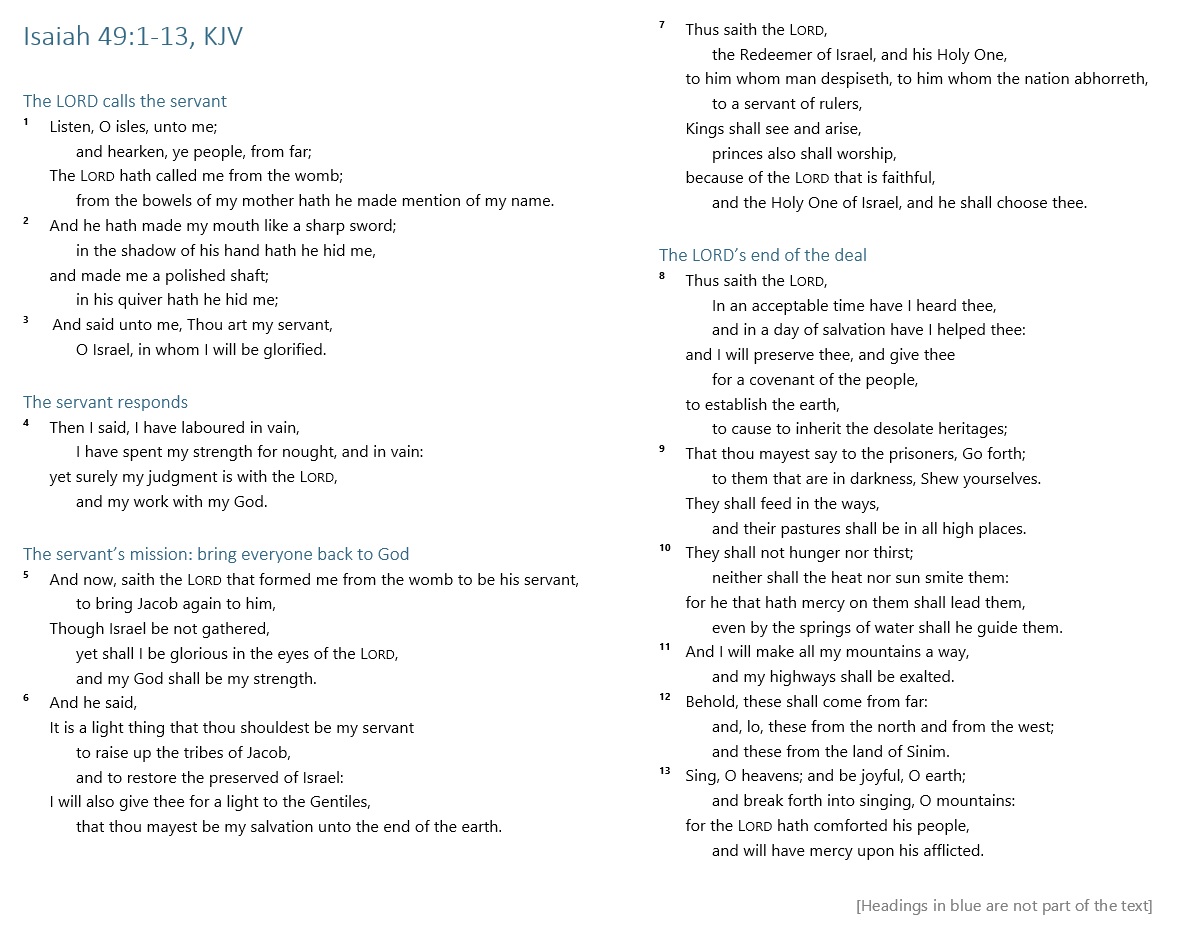
The first half is about the servant and his mission (bring people back to God), directly and indirectly, while the second half is God’s promise to do His part in this as well. Some consider “the servant song” to end at verse 7 (what I call the first half), and that makes perfect sense. It’s very subjective, as to where the “song” ends.
I quoted the KJV in the picture and did my best to section it off.
Something that will stick out in the KJV is the use of the word “Gentiles” in verse 6. We talked about this last Wednesday, with the first song. Other translations stick with the word “nations,” and I think that is truer to the context.
Theology and doctrine
Verse 3 – “You are my servant, Israel, in whom I will be glorified.”
So, is the servant Israel?
In the rest of the poem, the servant says “I” and “my,” as opposed to “we” or “our.”
You can take this in one of two ways:
- The servant is a single (real) person, representing an ideal Israel, or
- Israel is the servant, represented in the poem as a single (figurative) person
I lean toward #1, especially since I tend to see the servant as likely being Jesus Christ.
No responses yet